





RESEARCH
【Publication】Inhibition of Mincle signaling by chemically synthesized disaccharide-type 6- O-acylated steryl β-glucosides (βASGs) and their analogues derived from plants
September 1, 2026
Credits: WPI-Bio2Q
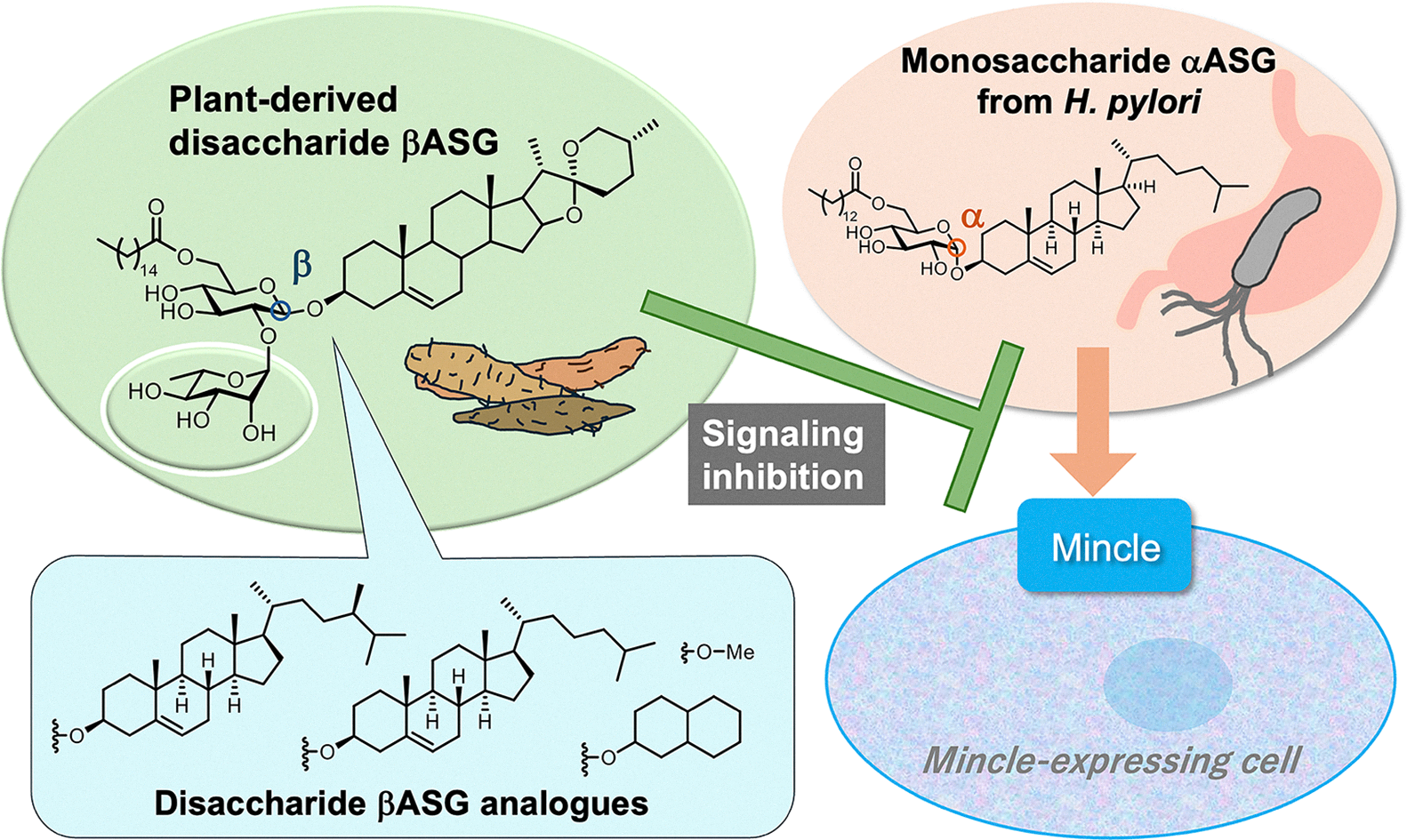
Visual Abstract
Credits: Yoshida et al., 2026
Co-authored by researchers at Bio2Q and published in Chemical Communications, this study discovered plant-derived compounds that suppress excessive inflammatory responses in the body. The researchers artificially synthesized components found in yams and investigated their effects on the immune mechanism. The results revealed that altering the structure of these compounds can inhibit the triggers of inflammation, contributing to the development of new therapeutics.
| Title | Inhibition of Mincle signaling by chemically synthesized disaccharide-type 6- O-acylated steryl β-glucosides (βASGs) and their analogues derived from plants |
|---|---|
| Authors | Kenji Yoshida 1, Takanori Matsumaru 1, Sho Yamasaki 2 3 4 5, Yukari Fujimoto 1 6 |
| Short Description |
This study, co-authored by a research team that including researchers from Bio2Q and Keio University, identifies plant-derived glycolipids that can inhibit signaling through Mincle, an immune receptor involved in inflammatory responses. While many previously identified Mincle ligands activate the receptor, relatively little is known about molecules that inhibit its signaling. Here, these researchers chemically synthesized a plant-derived disaccharide βASG found in yellow yam along with a series of related analogues and investigated their effects on Mincle activity. They found that several disaccharide βASGs strongly inhibited Mincle signaling while showing little ability to activate the receptor themselves. These compounds also suppressed signaling triggered by a glycolipid derived from Helicobacter pylori, which is associated with inflammatory responses in the stomach. By comparing different molecular structures, the researchers showed that the disaccharide framework together with sterol and fatty acid components plays an important role in determining inhibitory activity. These findings reveal how structural changes to glycolipids can switch their effects on Mincle from activation to inhibition and provide a foundation for developing new molecules that regulate Mincle mediated immune responses. |
| DOI | 10.1039/d6cc02089e |
| Journal | Chemical Communications |
| Vol/Num/Page |
62(59):14786-14789.
|
| Publication Date | July 30, 2026 |
Affiliations
1 Department of Chemistry, Faculty of Science and Technology, Keio University, Yokohama, 223-8522, Japan.
2 Department of Molecular Immunology, Research Institute for Microbial Diseases, The University of Osaka, Suita 565-0871, Japan.
3 Laboratory of Molecular Immunology, Immunology Frontier Research Center (WPI-IFReC), The University of Osaka, Suita 565-0871, Japan.
4 Division of Molecular Design, Medical Institute of Bioregulation, Kyushu University, Fukuoka 812-8582, Japan.
5 Division of Molecular Immunology, Medical Mycology Research Center, Chiba University, Chiba 260-8673, Japan.
6 Human Biology Microbiome Quantum Research Center (Bio2Q), Keio University, Tokyo 160-8582, Japan.
SHARE




More Bio2Q News
【Publication】Accurate, sensitive, and efficient chromatin accessibility quantifi...
Co-authored by researchers at Bio2Q and published in Nature Communications, this study developed a new analytical technology to accurately a...
【Publication】Mixed-class J-domain protein scaffolds promote expanded aggregate h...
Co-authored by researchers at Bio2Q and published in FEBS Letters, this study elucidates a new degradation mechanism by which human cells re...
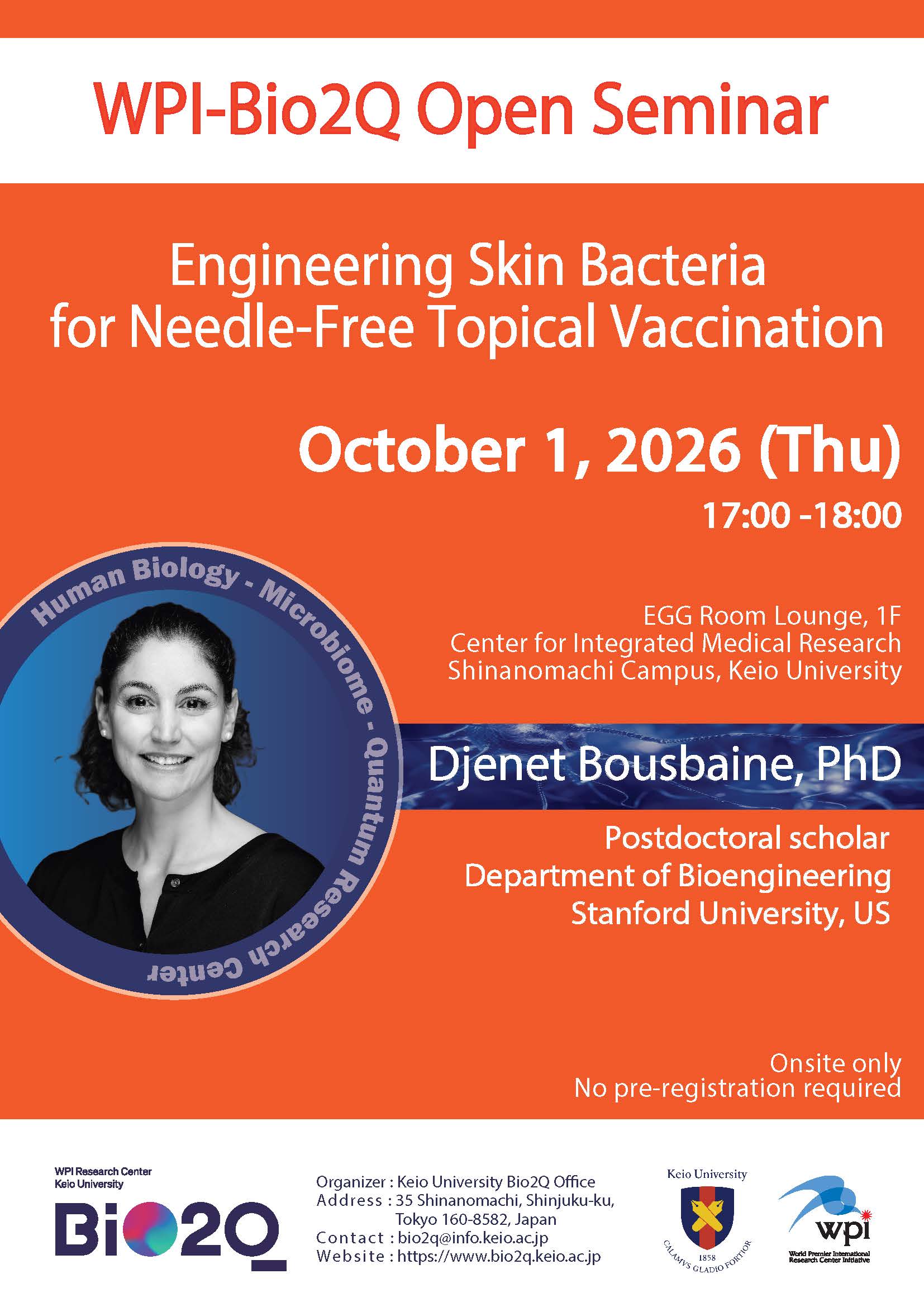
【10/1 Seminar】Bio2Q Open Seminar: Djenet Bousbaine, PhD
Keio University Human Biology-Microbiome-Quantum Research Center (WPI-Bio2Q) will hold a seminar as follows. This is an event for faculty, ...
【Publication】Lysophosphatidic acid drives to mirror-image pain via corpus callos...
Co-authored by Bio2Q researchers and published in Communications Biology, this study clarifies how lysophosphatidic acid (LPA) propagates in...
【Publication】Parallelizable search-space decomposition for large-scale combinato...
Co-authored by Bio2Q researchers (Scientific Reports), this study significantly accelerates large-scale optimization by splitting problems f...
