





RESEARCH
【Publication】A conserved tyrosine motif encodes a structural vulnerability controlling stability and activity across J-domain proteins
October 26, 2026
Credits: WPI-Bio2Q
Researchers from Bio2Q and collaborating institutions have identified a conserved structural element that regulates the stability and function of J-domain proteins, which help maintain protein quality control in cells. Disrupting this region can impair their ability to cooperate with Hsp70 molecular chaperones and clear harmful protein aggregates. These findings provide new insights into how cells regulate protein homeostasis and respond to stress.
| Title | A conserved tyrosine motif encodes a structural vulnerability controlling stability and activity across J-domain proteins |
|---|---|
| Authors | Narasimharaju Kalidindi, Anna Leder, Guillaume Mas, Mathieu Edouard Rebeaud, Siddhi Omkar, Sanjeev Uthishtran, Senthil Arumugam, Andrew W. Truman, Paolo De Los Rios, Sebastian Hiller & Nadinath Bandara Nillegoda |
| Short Description | Researchers from Bio2Q and collaborating institutions have identified a previously unrecognized mechanism that regulates the activity and stability of proteins responsible for maintaining protein quality control in cells. J-domain proteins (JDPs) work alongside Hsp70 molecular chaperones to help proteins fold correctly, prevent harmful protein aggregation, and maintain cellular health. However, how these proteins are regulated has remained poorly understood.
In this study, these researchers discovered that a small, evolutionarily conserved region of JDPs acts as a structural control element that is essential for their stability and function. By introducing modifications that mimic protein phosphorylation, the researchers demonstrated that disrupting this region can cause JDPs to lose their structural integrity, become degraded, or inhibit their ability to interact with Hsp70. These changes also impaired the clearance of protein aggregates and altered cellular stress responses. These findings reveal a potential mechanism through which cells may regulate their protein quality control machinery in response to changing conditions. This work provides novel insights into the molecular processes underlying cellular health, along with diseases associated with disrupted protein homeostasis, including neurodegenerative disorders. |
| DOI | 10.1038/s42003-026-10947-w |
| Journal | Communications Biology |
| Vol/Num/Page |
to be updated
|
| Publication Date | September 17, 2026 |
Author information
Nadinath Bandara Nillegoda
Present address: Keio University Human Biology-Microbiome-Quantum Research Center (WPI-Bio2Q), Keio University, Tokyo, Japan
These authors contributed equally: Narasimharaju Kalidindi, Anna Leder, Guillaume Mas.
Authors and Affiliations
Australian Regenerative Medicine Institute, Monash University, Clayton, VIC, Australia
Narasimharaju Kalidindi & Nadinath Bandara Nillegoda
Anatomy and Developmental Biology, Monash Biomedicine Discovery Institute, Monash University, Clayton, VIC, Australia
Narasimharaju Kalidindi
Biozentrum, University of Basel, Basel, Switzerland
Anna Leder, Guillaume Mas & Sebastian Hiller
Institute of Physics, School of Basic Sciences, École Polytechnique Fédérale de Lausanne-EPFL, Lausanne, Switzerland
Mathieu Edouard Rebeaud & Paolo De Los Rios
Institute of Bioengineering, School of Life Sciences, École Polytechnique Fédérale de Lausanne-EPFL, Lausanne, Switzerland
Mathieu Edouard Rebeaud & Paolo De Los Rios
Department of Biological Sciences, The University of North Carolina at Charlotte, Charlotte, NC, USA
Siddhi Omkar & Andrew W. Truman
European Molecular Biological Laboratory Australia (EMBL Australia), Monash Biomedicine Discovery Institute, Monash University, Melbourne, VIC, Australia
Sanjeev Uthishtran & Senthil Arumugam
Australian Research Council Centre of Excellence for Advanced Molecular Imaging, Monash University, Clayton, VIC, Australia
Senthil Arumugam
Corresponding authors
Correspondence to Sebastian Hiller or Nadinath Bandara Nillegoda.
SHARE


More Bio2Q News

WPI-Bio2Q now recruiting administrative staff– Deadline: January 11, 2027
WPI-Bio2Q Administrative Office is currently hiring administrative staff. We look forward to receiving applications from candidates with English proficiency who can support international researchers and anticipate to work at Bio2Q Administrative Office. Application Deadline: January 11, 2027 For more details, please refer to the application information at the link below, Application Info...

New Long-Term Internship Student-Mr. Kevin Deesy
Introducing a new Long-Term Internship Student of Bio2Q We are delighted to welcome Mr. Kevin Deesy as a new Long-Term Research Internship Student of Bio2Q. "Hello Bio2Q team, My name is Kevin Deesy, and I’m currently completing my Master’s in Sustainable Food at the Technical University of Munich (TUM), specializing in molecular biotechnology and microbiology. My research so far has take...

New Member - Dr. Augustinas Silale
Introducing new member of Bio2Q We are excited to welcome Dr. Augustinas Silale as a Jr. PI at Bio-2 Core of Bio2Q. "Hello, Bio2Q community! My name is Augustinas (August) Silale. I am from Lithuania. I am delighted to join Bio2Q as a Jr. PI. I read Natural Sciences at the University of Cambridge. My BA project was on fragment-based drug discovery in Prof Sir Tom Blundell’s group, where ...
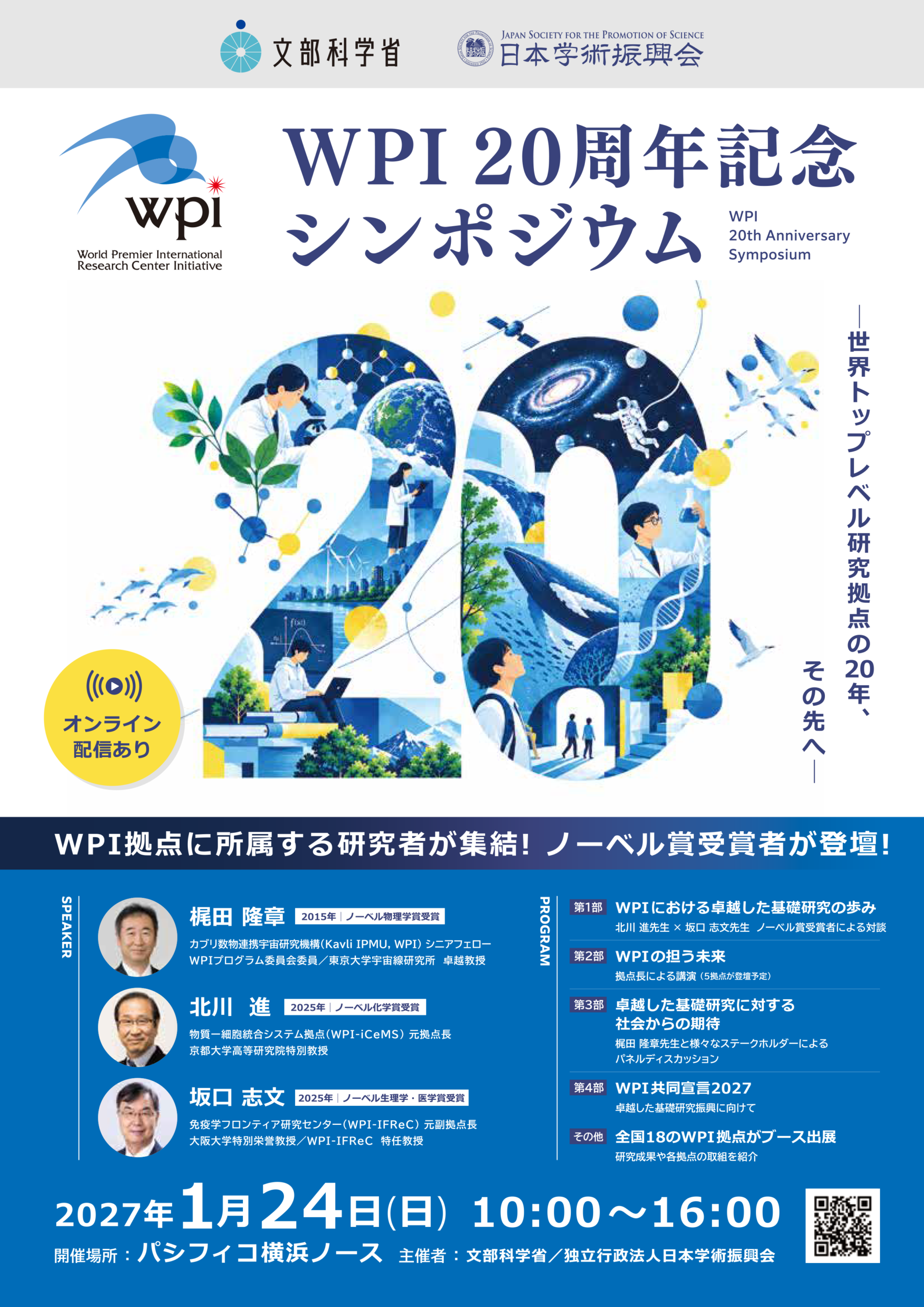
WPI 20th Anniversary Symposium "20 Years of World Premier International Research...
On Sunday, January 24, 2027, the "WPI 20th Anniversary Symposium" will be held at Pacifico Yokohama North with online streaming available, hosted by the Ministry of Education, Culture, Sports, Science and Technology (MEXT) and the Japan Society for the Promotion of Science (JSPS).Marking two decades of the World Premier International Research Center Initiative (WPI), this landmark symposium brings...
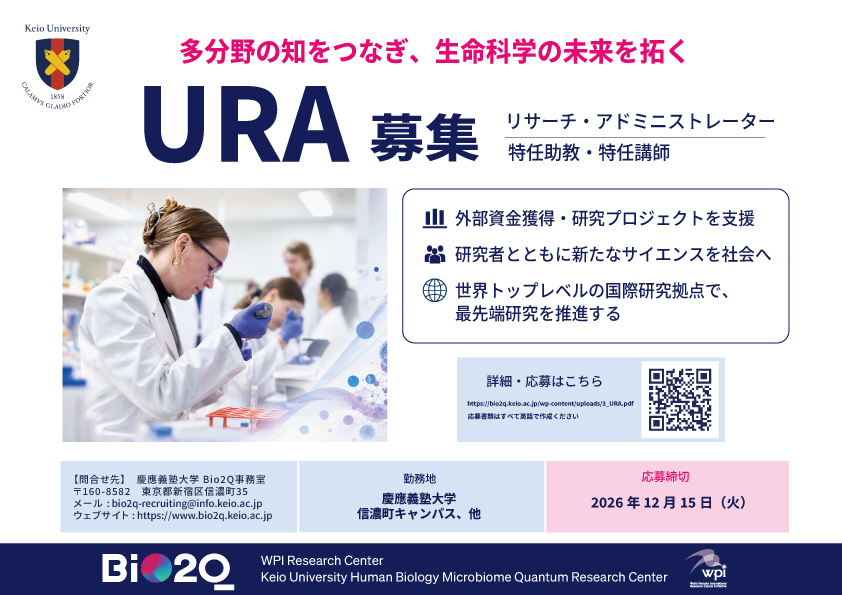
Open Call: Research Administrator (URA)
Bio2Q is seeking a Research Administrator (URA) (Project Instructor or Project Assistant Professor) to promote Bio2Q-related research through their own ideas and initiative. For further details, please refer to the link below. We look forward to receiving your application. Application Information → https://bio2q.keio.ac.jp/wp-content/uploads/3_URA.pdf
