





イベント
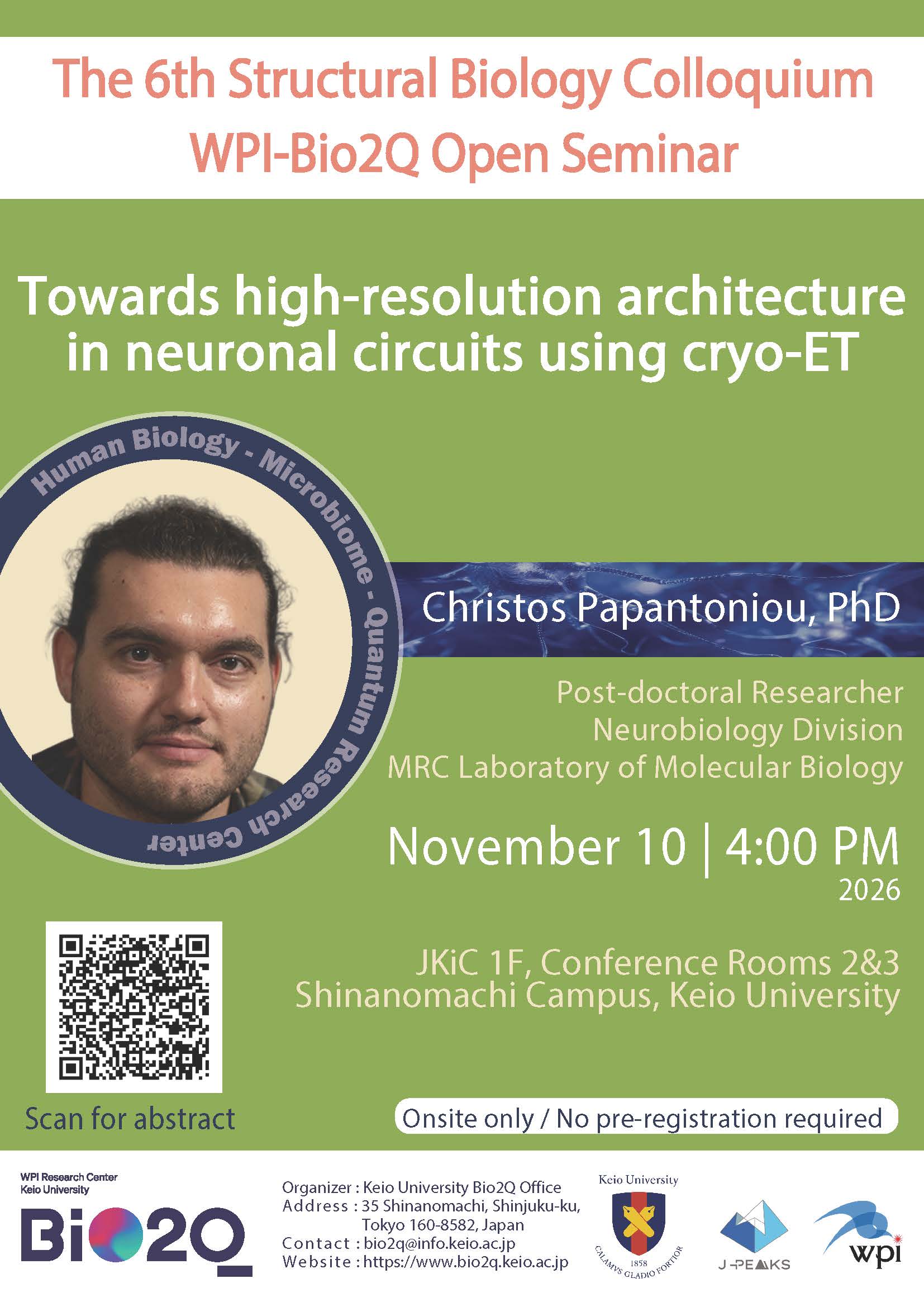
【11/10 セミナー】第6回 Structural Biology Colloquium / WPI-Bio2Q 公開セミナー
2026年10月13日
ポスター
Credits: WPI-Bio2Q
世界トップレベル研究拠点(WPI)慶應義塾大学ヒト生物学-微生物叢-量子計算研究センター(Bio2Q)は以下のとおり公開セミナーを開催いたします。
慶應義塾関係者の方であれば、どなたでもご参加いただけます。皆様のご参加を心よりお待ちしております。
| 日時 | 2026年11月10日 (火) 16:00~17:00 |
|---|---|
| 場所 | 慶應義塾大学 信濃町キャンパス JKiC 1階, 会議室2, 3 |
| タイトル | Towards high-resolution architecture in neuronal circuits using cryo-ET |
| 講演者 | Christos Papantoniou, PhD Post-doctoral Researcher Neurobiology Division MRC Laboratory of Molecular Biology |
| 言語 | 英語 |
| ポスター | |
| 事前登録 | 不要 |
概要 (Abstract):
Neuronal synapses are fundamental units for information transmission, processing and storage in the nervous system. In vertebrates, disruptions in the neuronal connectivity of circuits leads to problems like cognitive impairment and neurodegenerative disorders.
During my PhD studies at the Max-Planck Institute of Biochemistry, we used cryogenic electron tomography (cryo-ET) to investigate such disruptions in the presynaptic terminal, with synaptosomes as a model, and suggested a structural model of proximal synaptic vesicle priming and release. Although synaptosomes are great models in studying the ultrastructure of neuronal synapses, the integrity of neuronal circuits is lost in such studies. This circuit integrity is fundamental for properly studying the brain. Therefore, our aim at the MRC – Laboratory of Molecular Biology is to explore the connectivity and molecular architecture of neuronal synapses in tissue biopsies, using in situ cryo-ET. Despite the extraordinary potential of cryo-ET, the inherent challenges of reliably milling lamellae from tissue biopsies exceeding ~50 µm in thickness limit the broader applicability of this method. Current approaches (lift-out, trimming using cryo-ultramicrotomy) require extensive manual labour, additional sample transfer, and specialized expertise.
To tackle these issues, we developed a largely automated, lift-out-less, high-throughput pipeline for the fabrication of high-quality lamellae from animal tissue biopsies (> 150 µm) using plasma focused ion beam milling (pFIB). Our FIB workflow opens a new window for ultrastructural analysis of tissue biopsies and constitutes the backbone of our lab’s work on neuronal circuits.
シェア


ニュースをさらに見る:

WPI-Bio2Qニュースレター「Bio2Q Connect」Vol.2, Issue 19 発行
WPI-Bio2Qは、本日 (2026年10月29日)、ニュースレター『Bio2Q Connect』の最新号を発行いたしました 。今月号の主な掲載内容は以下のとおりです。 研究紹介(Introduction to Bio2Q Research): 研究者による、自分の研究分野や研究テーマを分かりやすい解説 新メンバー紹介(Welcome On Board!): 10月に着任した Jungho Sohn 氏の紹介 作品紹介:WPI-Bio2Q Science Art Gallery の出展作品の紹介 イベント予告・募集案内: 国際シンポジウム等の開催案内、リサーチインター...
【セミナー報告】第175回 Brain Clubセミナー(WPI-Bio2Q 公開セミナー)
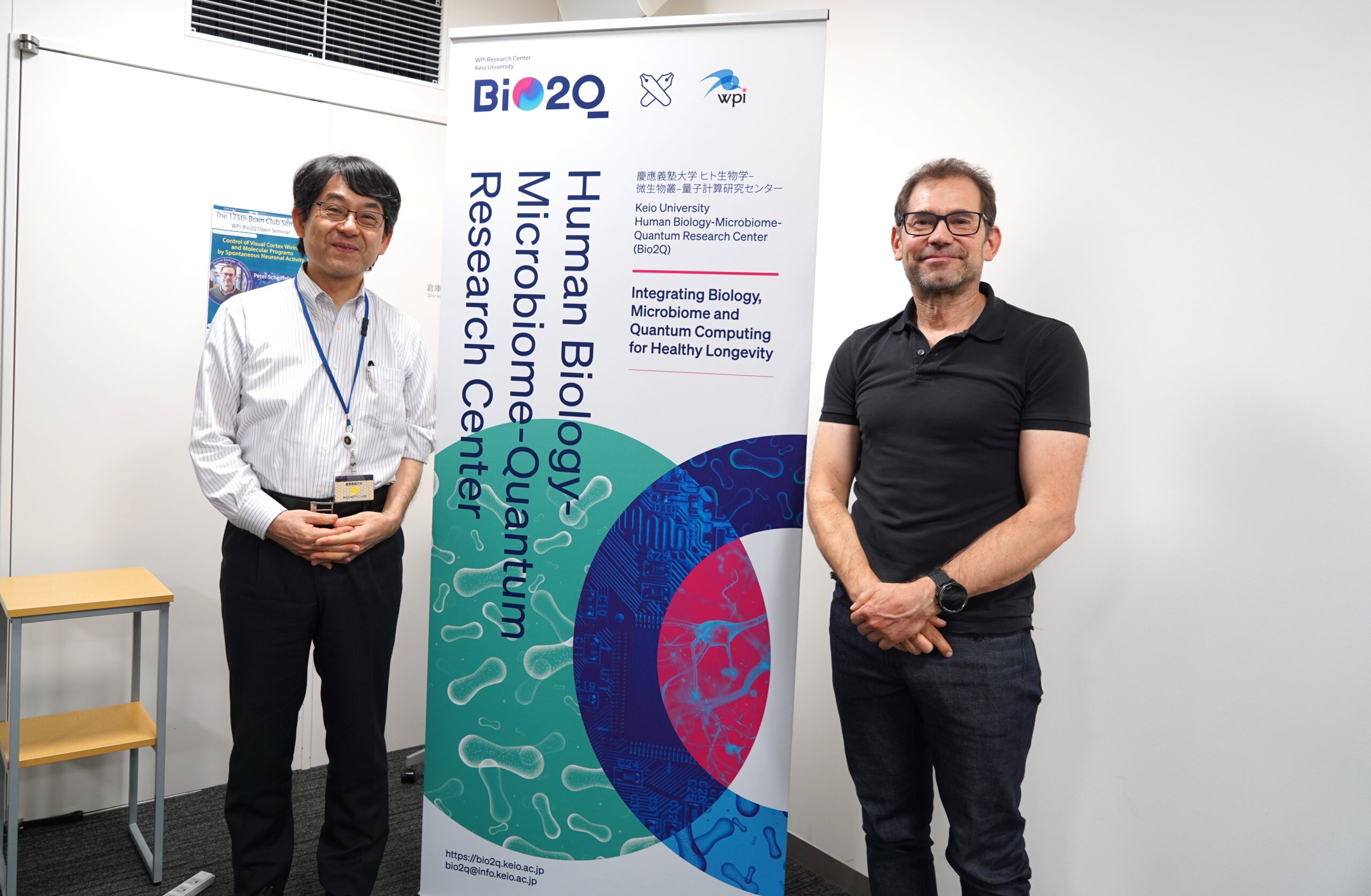
世界トップレベル研究拠点(WPI)慶應義塾大学ヒト生物学-微生物叢-量子計算研究センター(Bio2Q)は以下のとおり公開セミナーを開催しました。 日時:2026年10月22日(木)16:00-17:00 会場:慶應義塾大学 信濃町キャンパス JKiC 1階, 会議室2, 3 講演者:Peter Scheiffele, PhD Professor, Biozentrum, University of Basel, Switzerland 演題:Control of Visual Cortex Wiring and Molecular Progr...
【研究成果】量子アニーリングの難問を短時間で解く新たな可能性――誤り訂正モデルの有効性を発見
Bio2Qと慶應義塾大学の研究者らは、量子最適化問題の複製(レプリカ)同士に追加の相互作用を加えることで、量子アニーラの性能を高められることを示しました。この手法では、「フラストレーション」と呼ばれる相互作用の競合を活用します。これにより、計算時間が短い場合や、最適解と次に低いエネルギー状態との差が小さい難しい条件でも、最適解をより見つけやすくなります。今回の成果は、実用化が近い量子コンピュータの性能向上につながる可能性を示すものです。 タイトル A conserved tyrosine motif encodes a structural vulnerability cont...
【イベント 参加報告】2026慶應連合三田会大会
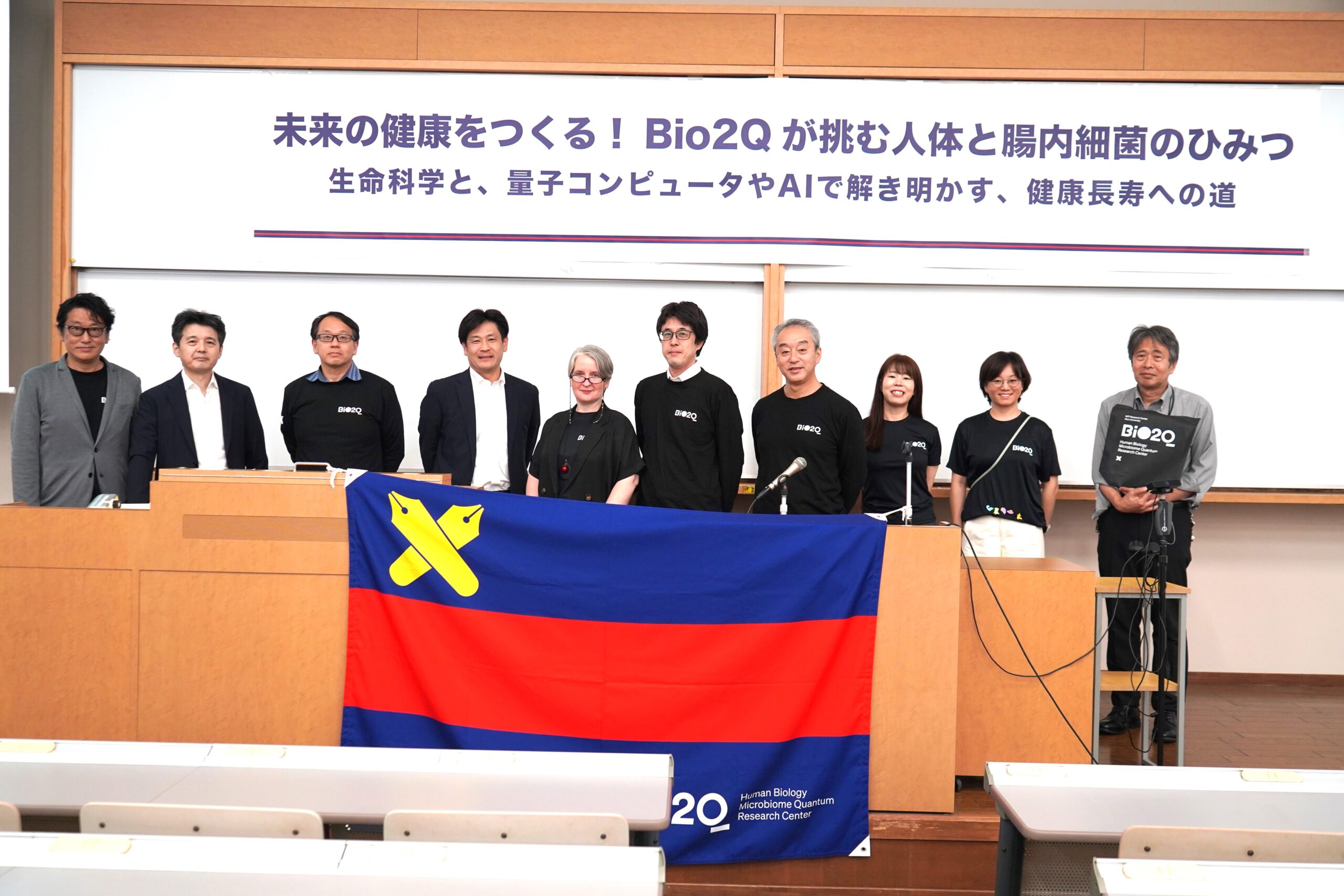
世界トップレベル研究拠点(WPI)慶應義塾大学ヒト生物学-微生物叢-量子計算研究センター(Bio2Q)は、以下のとおり、2026慶應連合三田会大会にて講演を行いました。 イベント概要 * イベント名: 2026年慶應連合三田会大会 Bio2Q特別講演 * 日時: 2026年10月18日(日)12:00~15:00(1回目:12:00~、2回目:13:00~、3回目:14:00~) * 場所: 慶應義塾大学 日吉キャンパス 第4校舎 B棟 2F J24教室 * 言語: 日本語 * テーマ: 「未来の健康をつくる! Bio2Qが挑む人体と腸内細菌のひみつ」〜生命科学と、量子コン...
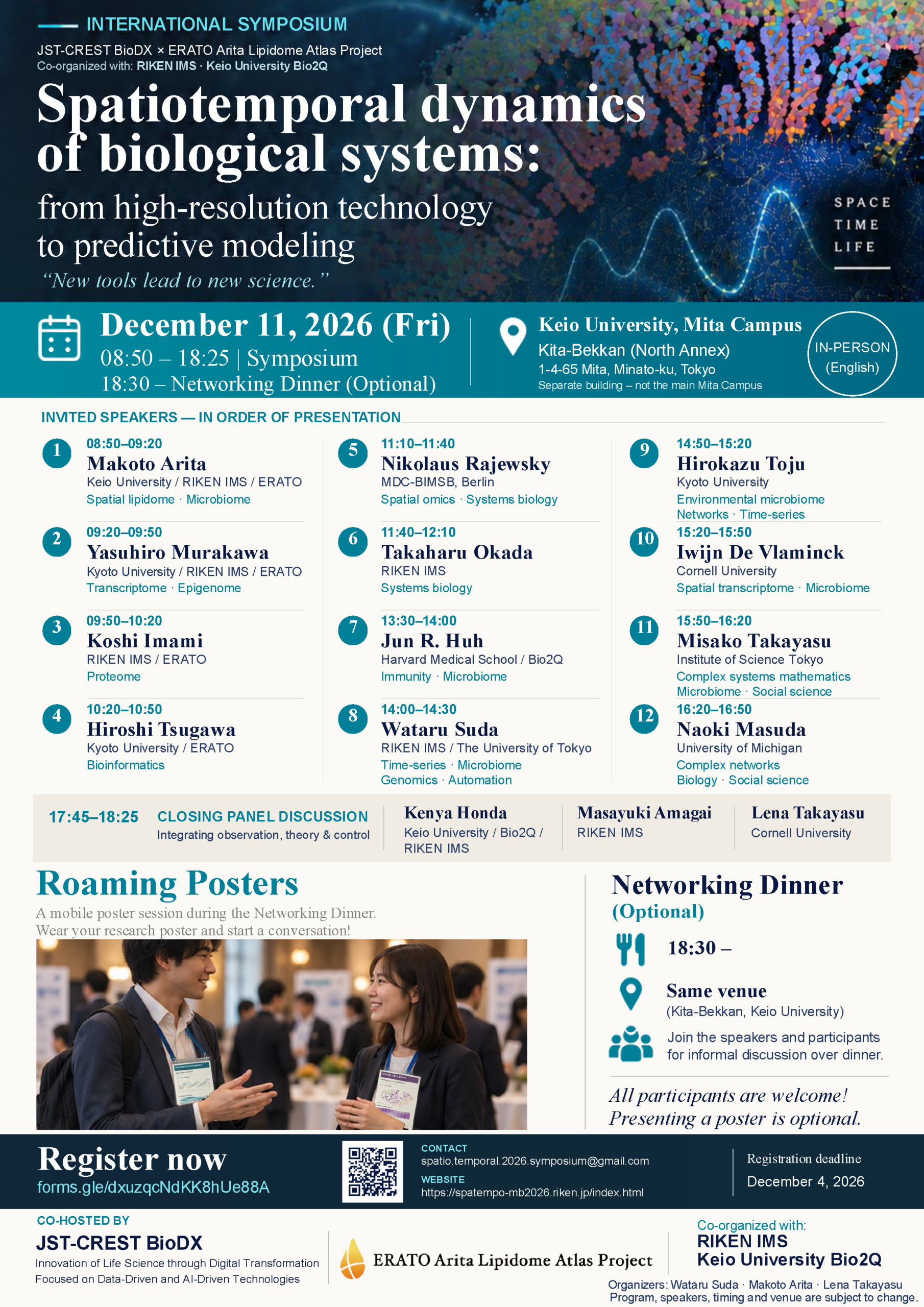
【お知らせ】JST-CREST BioDX / ERATO有田リピドームアトラスプロジェクト 共催国際シンポジウム「Spatiotemporal dynamic...
2026年12月11日(金)、慶應義塾大学三田キャンパス北別館にて、JST-CREST BioDXおよびERATO有田リピドームアトラスプロジェクト主催(理化学研究所IMS、慶應義塾大学Bio2Q共催)の国際シンポジウム「Spatiotemporal dynamics of biological systems: from high-resolution technology to predictive modeling」が開催されます。 本シンポジウムでは、最先端の計測・オミクス技術から予測モデル・理論に至るまで、生命システムの時空間ダイナミクスに関する国内外の第一線の研究者が集い、最先端...
